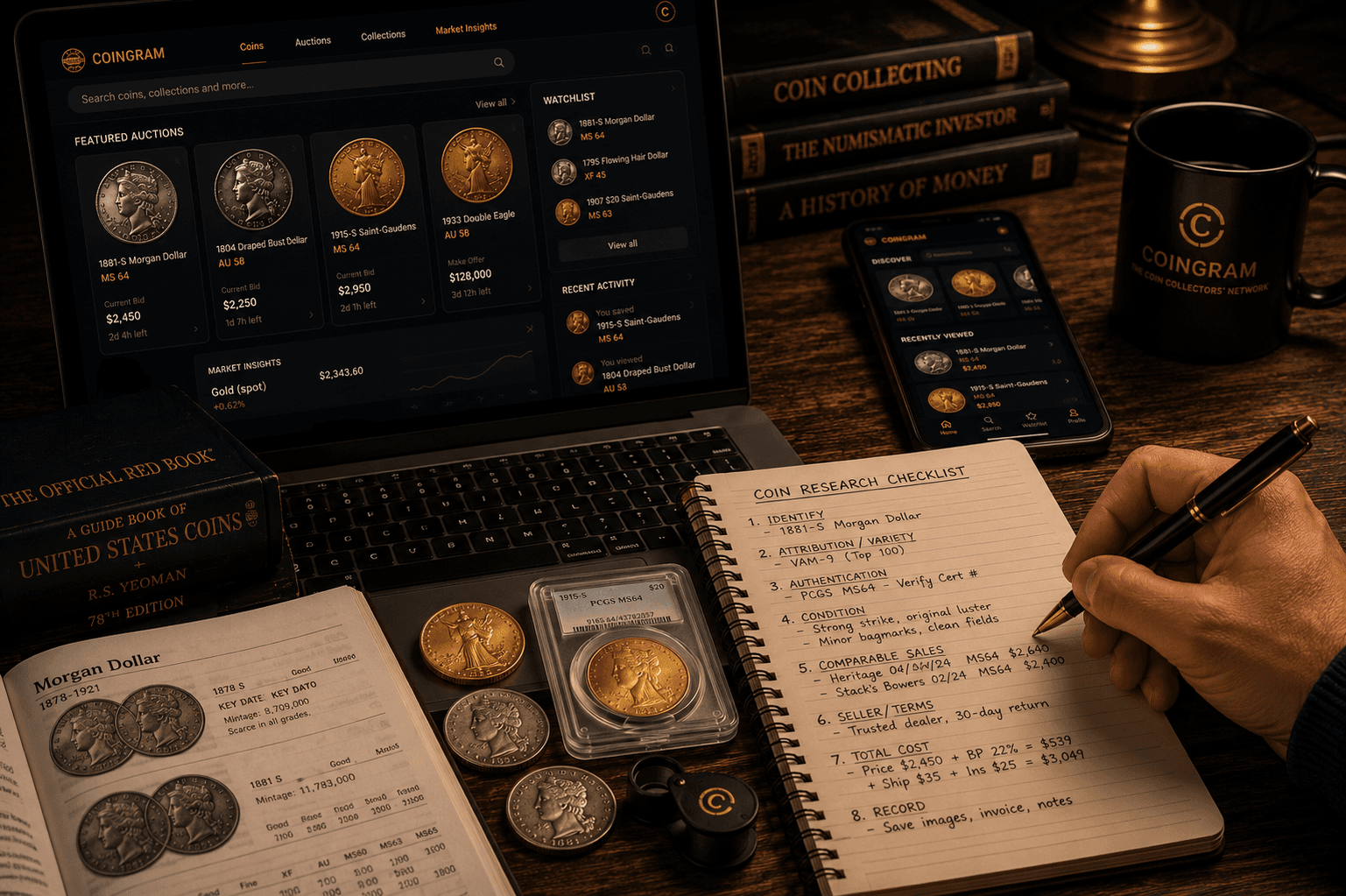
How to Research a Coin Before You Buy It
The best coin purchases rarely begin with a bid or a payment.
They begin with research.
Whether you are buying your first silver dollar, a British sovereign, an ancient bronze, a modern proof issue or a high-grade rarity, the objective is the same: understand exactly what you are buying before money changes hands.
Two coins that appear almost identical can have very different values. A small mintmark, a scarce variety, a better strike, original surfaces, a top population grade or a documented provenance can completely change the story.
The modern market gives collectors access to exceptional coins from around the world. That is a major opportunity, but it also makes disciplined research more important than ever.
Before you buy, work through these eight steps.
1. Identify the Coin Precisely
Start with the fundamentals.
Do not rely only on the seller’s title, especially when the coin is rare, unfamiliar or offered online. Confirm its exact identity independently.
For most coins, you should establish:
- Country or issuing authority
- Denomination
- Date
- Mintmark
- Metal, fineness and weight
- Diameter and edge type
- Type, variety or die attribution
- Whether it is a circulation strike, proof, specimen, pattern or commemorative issue
This may sound simple, but it is often where important differences begin.
A mintmark can separate a common coin from a scarce one. A variety may be overlooked in a generic listing. A proof coin and a business strike from the same year can have dramatically different market positions. For world and ancient coins, correct attribution can depend on ruler, mint, style, reference number, weight standard or historical period.
Do not buy a description. Buy a coin you have independently identified.
Use reliable catalogues, specialist references, auction archives and recognised coin databases to compare the piece in front of you with known examples.
2. Understand Rarity Beyond the Mintage Figure
Collectors are often drawn to low mintage figures. They matter, but they are not the entire story.
A coin with a low original mintage is not automatically rare today. Some issues were carefully preserved from the beginning, while others were heavily circulated, melted, damaged or lost. On the other hand, a coin produced in large numbers may be extremely difficult to find in outstanding condition.
When evaluating rarity, look beyond the original production total and ask:
- How many examples are believed to survive?
- How often does the coin appear at auction?
- Is it available regularly in lower grades but scarce in premium condition?
- Are there population reports for certified examples?
- Is the issue sought after by a large collector base?
- Does the coin have an important variety, historical association or design type?
A coin can be scarce overall but relatively available in circulated condition. Another may be common at lower grades but genuinely rare in Mint State, Proof or exceptional eye appeal.
Rarity is not only about how many were made.
It is about how many remain, in what quality, and how many collectors are competing for them.
3. Study the Coin’s Condition, Not Only the Grade
Condition is one of the strongest drivers of value, but a numerical grade is not the whole story.
A certified grade offers a useful shorthand for a coin’s preservation. However, two coins with the same grade can still differ significantly in strike, lustre, toning, marks, originality and overall visual presence.
That is why experienced collectors often say:
Buy the coin, not only the number on the label.
Look carefully at the actual piece being offered.
For raw coins, inspect the surfaces for signs of wear, cleaning, scratches, rim damage, corrosion, tooling, repairs, artificial toning or other problems. For certified coins, study the images just as carefully. A holder does not make every example equally attractive.
Questions to ask include:
- Does the coin have natural and original-looking surfaces?
- Are there hairlines, cleaning marks or scratches?
- Does the strike appear sharp for the issue?
- Is the lustre strong and appropriate for the type?
- Is the toning attractive, stable-looking and consistent?
- Are there distracting spots, contact marks or edge issues?
- Are the photographs sharp enough to judge the surfaces properly?
Photographs can be misleading. Lighting can hide hairlines, flatten relief, disguise surface problems or make a coin appear more brilliant than it is in hand. If the images are dark, heavily edited, too small or incomplete, request additional photographs before committing.
A good seller should be comfortable providing clear images of the obverse, reverse, edge and any areas that deserve closer examination.
4. Verify Certification and Attribution
Third-party grading can be a valuable tool, particularly for key-date coins, high-value coins and issues where counterfeits are common.
Certification can provide an independent opinion on authenticity and grade. It can also make a coin easier to compare, insure, store and resell. But certification should support your decision, not replace your judgment.
When buying a certified coin, verify the certification number directly through the grading company’s official verification tool. Check that the database record corresponds with the coin’s stated date, denomination, variety, grade and certification details.
Then compare the listing itself.
Does the coin shown in the seller’s photographs appear to match the certification record? Is the holder intact? Is the attribution correct? Are there any inconsistencies between the images, label and description?
For high-value coins, this simple step is essential.
At the same time, do not assume that every raw coin is automatically unsuitable. Many excellent coins remain uncertified, particularly in specialised areas of world, ancient and historical numismatics. The important question is whether the seller, documentation, imagery and research give you enough confidence in the exact coin being offered.
5. Compare Real Market Evidence
An asking price is not the same as a market value.
The strongest evidence usually comes from recent sales of genuinely comparable coins. Review auction results, fixed-price dealer sales, archived listings and market availability before deciding what a coin is worth to you.
Do not compare only the date and grade. A meaningful comparison should account for:
- Exact date and mintmark
- Variety or special designation
- Grading company and certification status
- Numerical grade
- Eye appeal and strike quality
- Provenance, pedigree or historical importance
- Whether the price was achieved at auction or through retail sale
- The date of the transaction
- The broader market environment at the time
One unusually high result does not set the value for every example. Likewise, one low sale may reflect a weak image, poor timing, a problem coin or a limited buyer pool.
Look for a range of relevant evidence.
Price guides are useful reference points, but they should not be treated as guarantees. Markets move. Collector demand changes. Precious-metal prices affect bullion-related coins. And some pieces command premiums because of characteristics that a basic price guide cannot fully capture.
Think of a price guide as a compass, not a contract.
6. Research the Seller as Carefully as the Coin
The quality of the transaction matters as much as the quality of the coin.
Before buying, take time to understand who is offering it. Look at the seller’s history, the standard of their descriptions, the consistency of their photography, their reputation in collector communities and their willingness to answer direct questions.
A responsible seller should be able to explain the basics of the item, disclose visible concerns and provide clear terms.
Review:
- Seller reputation and transaction history
- Specialisation in the coin type being offered
- Return policy
- Shipping and insurance arrangements
- Payment methods and buyer protection
- Whether the photographs are original to the coin
- Whether the description is detailed and specific
- Responsiveness to reasonable questions
Be cautious with vague descriptions, stock photographs, pressure tactics or sellers who avoid questions about certification, provenance, condition or return terms.
A collector does not need to distrust every seller. But trust should be supported by transparency.
7. Calculate the True Purchase Cost
Before you bid or buy, calculate the all-in cost.
For an auction purchase, the hammer price is not the final amount. For a dealer purchase, the listed price may still exclude shipping, insurance, payment fees or taxes depending on the transaction and location.
Your calculation should include:
- Coin price or hammer price
- Buyer’s premium, where applicable
- Shipping
- Insurance
- Taxes or VAT, where applicable
- Import duties or customs costs for cross-border purchases
- Payment processing or currency-conversion fees
This matters because a coin that appears to be a bargain at the hammer price may be considerably more expensive once every cost is included.
Set a realistic maximum before you bid. Base it on your research, your total acquisition cost and how strongly the coin fits your collection.
Discipline is one of the most valuable skills a collector can develop.
8. Record the Coin From Day One
The research should not end once the coin arrives.
Create a record for every purchase. Save the images, invoice, certification details, auction description, provenance information and any notes you made during the research process.
A strong collection record should include:
- Full coin identification
- Weight, metal and specifications
- Grade and certification number, if applicable
- Purchase date and total cost
- Seller or auction house
- Original images
- Invoice or receipt
- Provenance notes
- Storage location
- Your own notes on condition, rarity and significance
This helps you manage your collection more intelligently over time. It also supports insurance, future resale, provenance research and long-term planning.
Most importantly, it gives each coin context.
A collection is not simply a group of objects. It is a record of decisions, discoveries, history and personal interest built over time.
The Coingram Research Checklist
Before you buy, ask yourself:
- Have I identified the coin correctly?
- Do I understand its rarity beyond the mintage figure?
- Have I studied the exact coin’s condition and eye appeal?
- Have I verified the certification or attribution?
- Have I compared recent, genuinely similar sales?
- Do I trust the seller and understand the transaction terms?
- Have I calculated the full purchase cost?
- Have I saved the information needed to document the coin properly?
Great collections are built one informed decision at a time.
Research does not remove the excitement from the hunt. It gives the hunt more meaning. It helps you recognise quality, avoid preventable mistakes and buy coins that you will be proud to own years from now.
Coingram is being built to make that process easier: a place to discover coins, explore their history and specifications, organise your collection and connect with a community that understands why every detail matters.