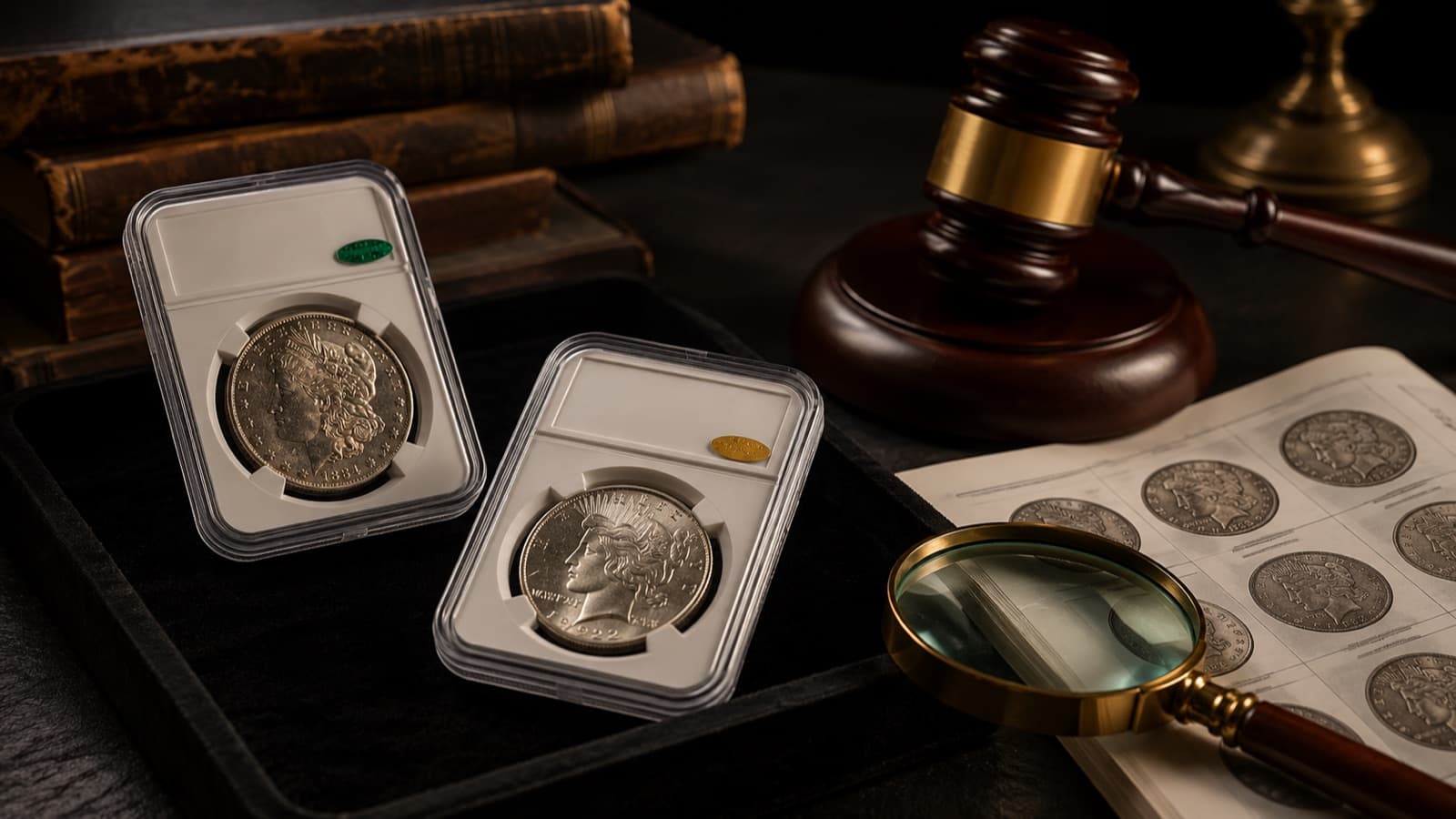
Few modern numismatic topics generate stronger opinions than CAC.
Some collectors see the sticker as one of the most useful quality signals in the market. Others argue that a coin should stand on its own, without needing another layer of approval beyond the original grading service. Both views contain some truth.
The real question is not whether CAC is famous.
The real question is whether CAC actually adds value to a coin in the marketplace.
The short answer is: often yes, but not automatically.
A CAC sticker does not magically turn an ordinary coin into a rarity. It does, however, signal to the market that the coin is solid or exceptional for the grade, and that added confidence can translate into stronger bidding. Recent auction results show that, in the right circumstances, CAC-approved coins can command meaningful premiums.
What CAC Is Actually Doing
CAC began as a stickering service for coins already certified by other grading companies. According to CAC, its role is to review third-party graded coins and identify those that meet or exceed CAC standards for the assigned grade.
CAC explains that:
- the green sticker is awarded to coins that meet CAC’s expectations for the grade
- the gold sticker is reserved for coins that exceed expectations for the grade
- less than half of submitted coins receive the green sticker
- the CAC sticker is intended to identify premium coins for the grade
That last phrase is the key.
CAC is not simply repeating the original grade. It is trying to answer a more specific market question: is this coin strong for the grade, or is it merely average?
That matters because two coins in the same numerical grade can look very different in hand.
Why the Market Cares
Collectors do not pay premiums for labels alone.
They pay premiums for confidence.
A coin with CAC approval tells a buyer that another respected layer of scrutiny has already taken place. In a market where eye appeal, originality, strike quality, toning and surface preservation can vary dramatically within the same grade, that extra confidence matters.
This is especially true in categories where tiny differences in quality can create very large differences in price:
- key-date classic U.S. coins
- condition-rarity coins
- toned or visually exceptional pieces
- registry-level material
- expensive gold coins
- coins where the spread between a low-end and high-end example of the same grade is significant
In practical terms, CAC often matters most when buyers are already competing for quality.
The Most Important Principle: CAC Does Not Replace the Coin
“CAC can support value, but it does not replace the need to evaluate the exact coin.”
Before looking at auction results, one principle needs to stay clear.
A weak date with little collector demand will not become extraordinary just because it has a sticker. A common coin in an inactive market may show little premium. And a coin with great eye appeal but no sticker may still outperform a CAC coin of lesser visual quality.
The sticker is not the whole story.
It is part of the story.
What Recent Auction Results Suggest
The strongest evidence comes from how buyers behave when real money is at stake.
Recent 2026 auction results show several CAC-approved coins attracting record prices or unusually strong bidding. That does not prove that CAC was the only reason for the result, but it does show that buyers were willing to pay aggressively for coins combining rarity, quality and CAC approval.
1905-S Barber Quarter, MS-67 PCGS CAC — $53,680
In Stack’s Bowers Galleries’ June 2026 Showcase Auction, a 1905-S Barber Quarter graded MS-67 by PCGS and carrying CAC approval realized $53,680.
Stack’s Bowers described it as the probable finest known coin and noted that it shattered all records, with the previous auction record listed as $11,000 from the 1997 Eliasberg sale.
This is an important example because it shows how CAC often matters most at the very top of the quality ladder. This was not an ordinary certified Barber quarter. It was an elite-condition coin in a classic series, and the CAC approval strengthened market confidence in that status.
1868 Liberty Head Eagle, Proof-64 PCGS CAC — $146,400
Another striking result from the same June 2026 sale was the 1868 Liberty Head Eagle graded Proof-64 by PCGS with CAC approval, which realized $146,400.
Stack’s Bowers said the coin sold for nearly three times the previous auction record for the date and for more than double the PCGS Price Guide value.
Again, this does not mean the sticker alone created the premium. The coin was already a rare Proof gold issue. But CAC likely helped confirm to bidders that they were competing for a premium example within a scarce and expensive category.
1955 Doubled Die Lincoln Cent, MS-64 RB PCGS CAC — $14,640
In the more broadly collected Lincoln-cent market, a 1955 Doubled Die Obverse cent graded MS-64 RB by PCGS and CAC-approved realized $14,640 in the June 2026 Stack’s Bowers Showcase Auction.
The firm described it as a record price for the grade.
That matters because the 1955 Doubled Die is one of the most recognizable U.S. varieties. Buyers know the coin, and they know that examples in the same grade can vary considerably in color, surfaces and eye appeal. In that context, CAC again appears to function as a confidence enhancer.
The Heritage Signal: CAC Has Its Own Auction Gravity
One of the clearest signs that CAC has market weight is that Heritage Auctions runs dedicated CAC-approved coin sales.
Heritage’s past-auction archive shows a “CAC Approved Coinage US Coins” sale in April 2026 that realized $595,726 from 997 bidders.
That figure alone does not prove that every CAC coin carries a large premium. But it does show that there is a distinct buyer base willing to pursue CAC-only material in a specialized sale environment.
In other words, CAC is not merely a footnote in the market. It has become a category that many buyers actively track.
Why Premiums Happen
When CAC adds value, it usually happens for one or more of these reasons:
1. It Narrows Quality Uncertainty
A numeric grade can contain a wide range of actual quality. CAC helps narrow that uncertainty by identifying coins it views as premium for the grade.
2. It Increases Buyer Confidence
In competitive auctions, confidence is valuable. Buyers are often more aggressive when they believe the coin has already passed an additional quality filter.
3. It Supports Registry and Set-Building Competition
For advanced collectors, especially those pursuing top sets, CAC approval can become part of the target profile. This is particularly true when building high-end classic U.S. coin sets.
4. It Can Matter More Than a Higher Number in Some Cases
A strong CAC coin in one grade may be more appealing than a non-CAC coin one point higher, especially if the non-CAC coin is seen as low-end for the grade or less attractive in hand.
That is one of the reasons CAC continues to shape bidding behavior: it reinforces the idea that quality within the grade matters, not just the number on the holder.
When CAC Does Not Add Much
It would be a mistake to claim that CAC always adds value in the same way.
There are many situations where the premium can be modest, inconsistent or almost irrelevant:
- very common coins with abundant high-grade supply
- thinly traded niches with limited buyer competition
- lower-value coins where the market cares more about cost efficiency than subtle quality distinctions
- coins whose eye appeal is already obvious enough that buyers do not need extra reassurance
- markets where the price spread within the grade is narrow
In those cases, CAC may still be a positive signal, but it may not produce a dramatic financial effect.
Green Bean vs Gold Bean
Collectors should also distinguish between the two types of CAC sticker.
Green Sticker
The green sticker indicates that CAC believes the coin meets its expectations for the assigned grade. This is the more common CAC outcome, though CAC says fewer than half of submitted coins receive it.
Gold Sticker
The gold sticker is rarer and indicates that the coin exceeds CAC’s expectations for the grade. In practical terms, the market often views a gold-sticker coin as undergraded or unusually strong.
Not surprisingly, gold-bean coins can attract particularly strong premiums.
CAC vs CACG
Today, collectors also need to distinguish between CAC stickering and CACG grading.
Originally, CAC’s main role was to evaluate coins already certified by other grading companies. More recently, CAC has also become a grading service itself, with coins encapsulated in CAC holders.
That means the market now interacts with CAC in two related but different ways:
- coins graded by another service and stickered by CAC
- coins graded directly by CACG
For many buyers, both paths still revolve around the same core idea: an added emphasis on strict quality standards.
So, Does CAC Really Add Value?
In a broad market sense, yes.
“CAC often adds value when the coin already has the rarity, demand and quality profile that makes confidence matter.”
But the better answer is more precise.
The premium is usually not created by the sticker alone. It is created by the combination of:
- an already desirable coin
- high-end quality for the grade
- visible buyer confidence
- and a competitive market environment
That is why some CAC coins sell for only modest premiums while others break records.
A Practical Coingram Takeaway
Collectors should not buy a sticker blindly.
They should buy the coin, using the sticker as one more useful piece of evidence.
A smart approach looks like this:
- Study the exact coin first
- Understand the rarity and demand profile
- Compare recent auction results
- Note whether the coin has CAC approval
- Decide whether the CAC premium is justified for that specific coin
That approach keeps CAC in its proper place: important, useful and often valuable, but never more important than the coin itself.
Final Thoughts
CAC matters because trust matters.
In a market where two coins with the same grade can perform very differently, a respected quality signal can influence how aggressively collectors bid. Recent auction results make that clear.
The strongest premiums tend to appear when CAC approval is attached to coins that are already scarce, high-end and competitive.
So yes, CAC can add value.
But it adds the most value when it confirms something the best collectors already care about: that quality is not just a number.