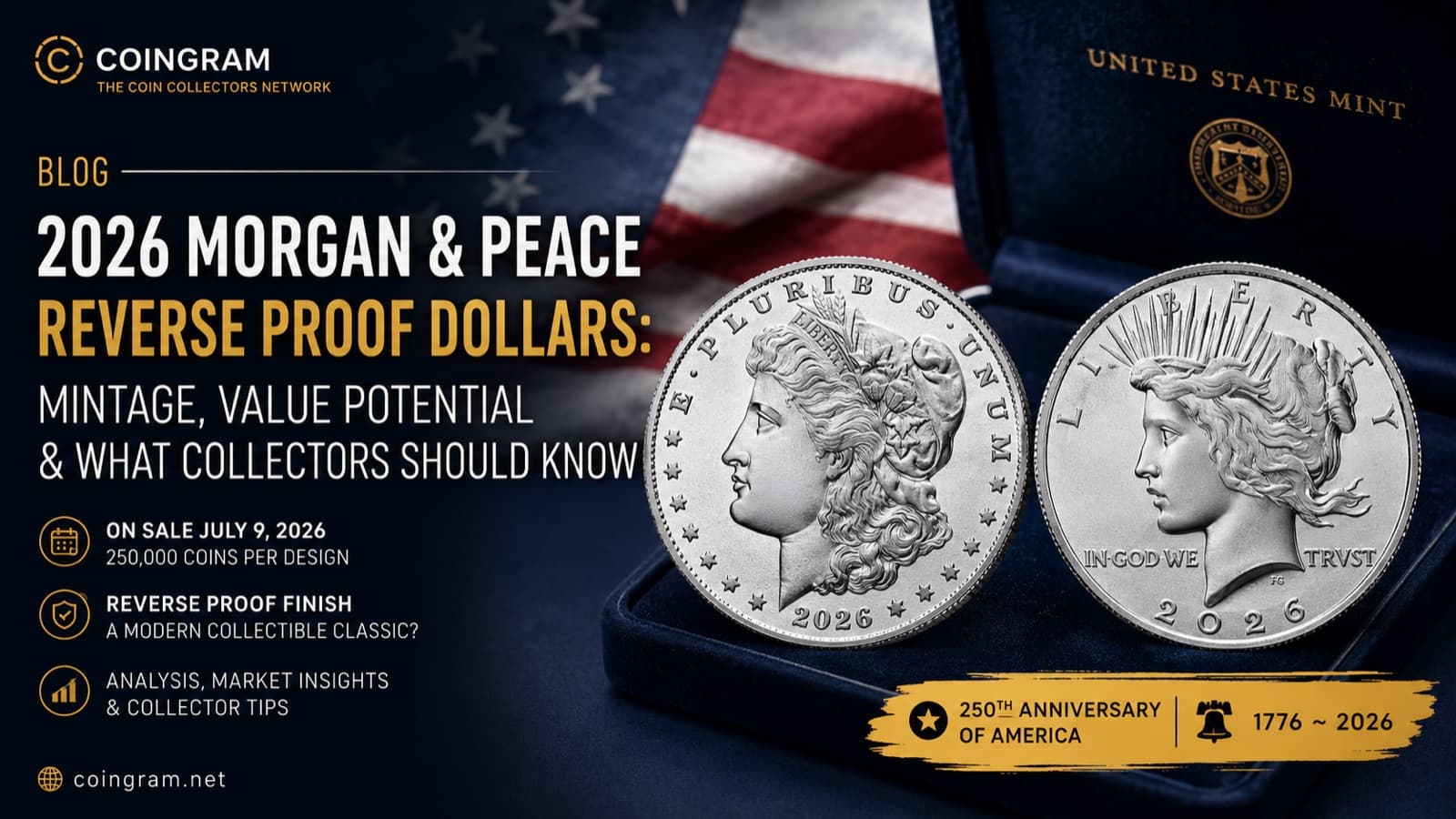
Two of the most recognisable silver-dollar designs in American numismatics return in 2026 with a new historical layer.
The United States Mint is releasing a 2026 Morgan Reverse Proof Silver Dollar and a 2026 Peace Reverse Proof Silver Dollar to mark the 250th anniversary of American independence. Both coins carry the dual date 1776 ~ 2026, a Liberty Bell privy mark bearing the numeral 250, and a Philadelphia P mint mark.
For collectors, this is not simply another annual modern issue.
The 2026 coins sit at the meeting point of several collecting stories: the original Morgan Dollar, the original Peace Dollar, the modern revival that began in 2021, and America’s Semiquincentennial celebration.
Each coin has a production limit of 250,000 pieces, is struck in .999 fine silver, contains 0.859 troy ounce of silver, and is priced by the U.S. Mint at $173. Orders open on July 9, 2026, at noon Eastern Time, with a household order limit of 10 per product during the first 24 hours.
But are 250,000 coins per design really limited? And do the 2026 Morgan and Peace Reverse Proof Dollars have genuine long-term collector potential?
The 2026 Release at a Glance
Before looking at value potential, it is important to understand exactly what the Mint is offering.
Both the 2026 Morgan and Peace Reverse Proof Dollars share the same core specifications:
- Denomination: $1
- Mint: Philadelphia (P mint mark)
- Finish: Reverse Proof
- Composition: .999 fine silver (0.859 troy ounce)
- Diameter: 38.10 mm
- Production limit: 250,000 per design
- U.S. Mint issue price: $173
- Anniversary features: 1776 ~ 2026 dual date and a Liberty Bell “250” privy mark
The Morgan Dollar design was created by George T. Morgan and originally appeared from 1878 through 1904, then once more in 1921. The Peace Dollar, designed by Anthony de Francisci, followed in 1921 and was struck through 1935.
The modern U.S. Mint program revived both designs in 2021. The 2026 release is therefore not a new series, but a special one-year chapter within an already popular modern continuation.
Why 2026 Is Different
The 2026 coins have several details that distinguish them from the recent modern Morgan and Peace Dollars.
A Semiquincentennial Dual Date
The obverse carries the dual date 1776 ~ 2026 rather than a standard single-year date.
That alone makes the 2026 coins easy to identify as anniversary issues. The dual-date format deliberately echoes the 1776–1976 Bicentennial coinage, which remains one of the most widely recognised modern U.S. commemorative themes.
A Liberty Bell “250” Privy Mark
Both reverse proof dollars include a special Liberty Bell privy mark with the numeral 250.
Privy marks have become an important element of modern collecting because they create a visually distinct variety within a broader coin program. In this case, the mark connects the designs directly to the 250th anniversary rather than functioning as a small decorative addition.
For Morgan and Peace Dollar specialists, the combination of the dual date and the Liberty Bell privy mark gives the 2026 coins a clearly separate place in the modern series.
A Philadelphia Reverse Proof
Recent reverse-proof Morgan and Peace releases were associated with San Francisco. The 2026 coins shift the reverse-proof format to Philadelphia and carry the P mint mark.
That change matters to completion-focused collectors. A modern series is often built around finish, mint, packaging, labels and year-by-year distinctions. The Philadelphia origin gives the 2026 reverse proofs another meaningful point of difference.
Separate Products, Not One Required Set
The U.S. Mint is offering the 2026 Morgan and Peace Reverse Proof Dollars as separate products at $173 each.
That makes the release more flexible for collectors. Someone who focuses only on Morgan Dollars can buy the Morgan, while a Peace Dollar specialist can buy the Peace. At the same time, many collectors will view them as a natural pair because their shared 1921 origin and 2026 anniversary features tell one continuous story.
What Does “250,000” Really Mean?
A production limit of 250,000 is meaningful, but it is not a guarantee of rarity.
The correct question is not simply whether 250,000 sounds low. It is how that number compares with the coin’s expected collector demand, the number preserved in premium condition, and the number of buyers who want the issue years after its release.
For a mass-circulation coin, 250,000 pieces would be a tiny number. For a modern U.S. Mint silver-dollar product, it is a substantial but clearly defined collector issue.
It is useful to separate four ideas:
Production limit
The maximum number the Mint says it will produce.Sell-through
The number actually purchased by collectors and dealers.Survival in premium condition
Even proof coins can develop haze, spots, handling marks or packaging issues over time.Long-term collector demand
This is what ultimately determines whether a coin becomes a standard modern issue or a sought-after key date.
The mintage figure is the beginning of the story, not the conclusion.
Reverse Proof: Why the Finish Matters
A reverse proof uses the opposite visual relationship from a traditional proof coin.
On a standard proof, the fields are typically mirrored and the design elements are frosted. On a reverse proof, the fields are generally frosted while Liberty, the eagle, inscriptions and other raised details show a mirror-like brilliance.
This finish works especially well on the Morgan and Peace designs.
The Morgan Dollar has a detailed Liberty portrait, bold stars and a heavily structured eagle reverse. The Peace Dollar has more open fields, a radiant crown and an eagle design that creates a very different visual effect under reverse-proof treatment.
For modern collectors, finish matters because it affects both visual appeal and registry-set demand. A reverse proof is not simply an “uncirculated coin with better packaging.” It is a distinct production style that many collectors assemble as a separate category.
The Numismatic Premium Is the Main Purchase
Each coin contains 0.859 troy ounce of silver, but the U.S. Mint price is $173.
That difference is not a problem by itself. It simply means buyers are paying primarily for numismatic factors:
- The Morgan or Peace Dollar design
- The reverse-proof finish
- The America 250 dual date
- The Liberty Bell privy mark
- The official Mint packaging and certificate of authenticity
- The defined production limit
- Potential grading and registry-set demand
Collectors should therefore avoid evaluating these coins as bullion purchases.
The silver content gives them an underlying precious-metal component, but the buying decision is fundamentally about design, historical theme, condition and future collector demand.
Could the 2026 Coins Gain Value?
They have credible collector potential, but no modern Mint product comes with a guaranteed outcome.
Several factors could support long-term demand.
1. Morgan and Peace Dollars Have a Large Collector Base
The Morgan Dollar is one of the most collected U.S. coin types, while the Peace Dollar has strong demand among collectors of 20th-century American silver dollars.
The modern program benefits from that established interest. Buyers are not being asked to learn an unfamiliar series from the beginning. The 2026 issues build on designs that already have generations of collector recognition.
2. The America 250 Theme Is a One-Year Event
The Semiquincentennial is a major national anniversary. The dual date and privy mark give the 2026 coins a feature that is unlikely to appear in an ordinary future year.
One-year-only design changes often become important reference points within modern series, especially when the anniversary is historically significant and the coins are easy to distinguish.
3. Condition Could Separate the Best Examples
Modern proof coins are made for collectors, so many examples will likely survive well. That means common grades may remain readily available.
The market may instead focus on exceptional examples: coins with strong eye appeal, deeply contrasting surfaces, clean fields, no spotting and top certification grades.
This is where grading companies, population reports and registry sets can matter. A coin in an average proof grade may trade differently from a coin at the top of a grading population, particularly when demand for labels or set rankings becomes competitive.
4. Original Packaging May Matter
For modern Mint products, complete original presentation packaging and the certificate of authenticity can be important to some buyers.
Collectors who purchase the coins should keep the boxes, sleeves and certificates in good condition. This may not add value to every example, but it helps preserve the product as originally issued.
Reasons to Stay Disciplined
There are also reasons to avoid overpaying.
A Modern Issue Is Not Automatically a Key Date
A limit of 250,000 is not the same as an ultra-low mintage. If demand is moderate and many coins are preserved carefully, supply may remain ample.
Collectors should not assume that a 2026 anniversary issue will follow the price path of a classic rarity.
Early Premiums Can Be Emotional
New releases often attract a rush of first-week excitement. Dealer listings, grading-label promotions and social-media discussion can push asking prices above a sustainable market level.
An asking price is not a completed sale.
Before paying a premium after the Mint release, check real transactions, compare available supply and decide whether you are buying the coin for your collection or speculating on a short-term increase.
Labels Are Not the Same as Rarity
Early Releases, First Releases, special anniversary labels and signature labels may be attractive to some buyers. But the underlying coin should remain the priority.
A label can improve presentation or fit a registry set, yet it does not automatically make an otherwise common modern issue scarce. The strongest premiums tend to appear when the coin, condition, designation and buyer demand all align.
A Practical Buying Framework
The 2026 Morgan and Peace Reverse Proof Dollars may be suitable for collectors who:
- Already collect modern Morgan or Peace Dollars
- Build U.S. Mint anniversary or privy-mark sets
- Appreciate reverse-proof coinage
- Want a 250th-anniversary issue with a clear historical story
- Plan to keep the coins long term
- Can buy at the original Mint price without relying on a future resale premium
They may be less suitable for buyers whose main goal is immediate profit.
Before buying, ask:
- Do I want the Morgan, the Peace, or both?
- Am I buying because I value the 2026 anniversary features?
- Do I understand that the price is mainly numismatic rather than silver value?
- Will I preserve the packaging, certificate and coin properly?
- If I choose to grade the coin, have I considered the grading fee, shipping, insurance and possible outcome?
How to Store Them Properly
Modern silver coins can be affected by fingerprints, humidity, packaging damage and surface contamination.
Keep the coins in their Mint capsules and presentation boxes. Store them in a stable, dry environment away from direct sunlight and extreme temperature changes. Avoid opening capsules unnecessarily or touching coin surfaces.
If you submit a coin for grading, use a reputable grading service and preserve the original Mint materials separately.
Final Verdict: Are They “Limited”?
Yes, in a meaningful modern U.S. Mint context.
Each coin has a clearly stated production limit of 250,000, a special reverse-proof finish, a 250th-anniversary dual date, a Liberty Bell “250” privy mark and a Philadelphia mint mark. Those details give the 2026 Morgan and Peace Dollars a strong identity within the modern program.
But “limited” should not be confused with “guaranteed to rise in value.”
Their long-term performance will depend on sell-through, condition rarity, grading populations, collector demand and the staying power of the America 250 theme after the initial release excitement fades.
For collectors who value the history and designs, the 2026 reverse proofs are among the most distinctive modern U.S. Mint releases of the year.
For buyers focused only on resale, patience and disciplined market research will matter more than release-day enthusiasm.