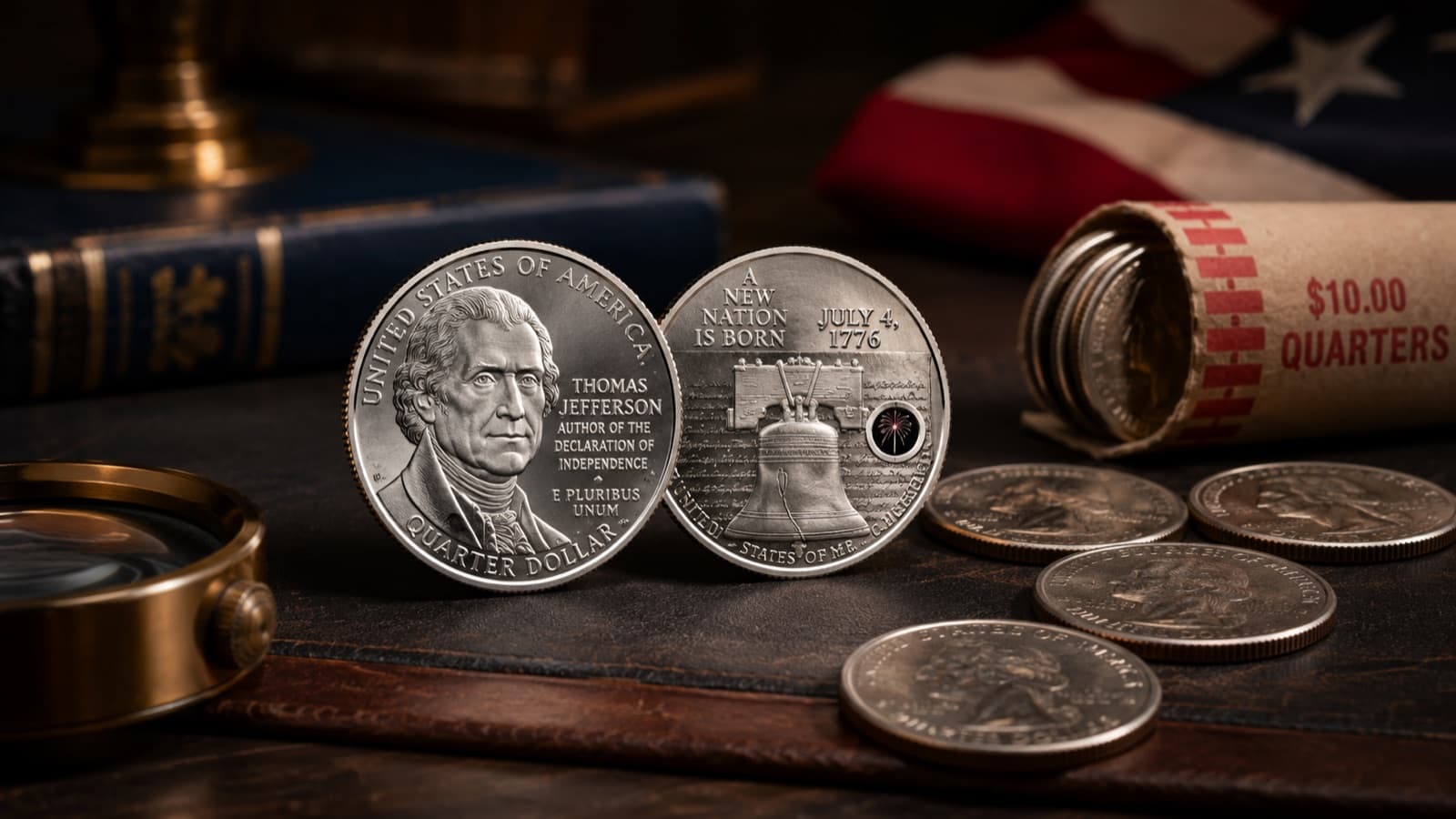
Most people see a quarter.
Collectors may see one of the most interesting modern circulation coins issued by the United States Mint in years.
In 2026, the United States marks 250 years since the Declaration of Independence. To commemorate that anniversary, the U.S. Mint introduced one-year-only changes across major circulating coinage and released a special Declaration of Independence quarter.
But one version has attracted particular attention: the limited “July 4th” privy-mark quarter.
Only 250,000 examples were announced for circulation, making it very different from an ordinary modern quarter. The Mint placed them randomly into circulation, turning everyday change into a national coin hunt.
So what exactly is this coin, how can collectors identify it, and does it have real long-term value potential?
The 2026 Declaration of Independence Quarter
The 2026 Declaration of Independence quarter is part of the United States Mint’s Semiquincentennial programme, created to mark America’s 250th anniversary.
The regular issue features Thomas Jefferson on the obverse, together with the dual date 1776 ~ 2026. The reverse depicts the Liberty Bell ringing, with the Bell’s visible crack used as a reminder of the fragility of the young nation at its founding.
Regular circulation examples were struck at Philadelphia and Denver, carrying the familiar P or D mint marks. The Mint also offered circulating-quality rolls and bags for collectors.
These regular pieces are historically significant because they are part of a one-year national redesign programme. But they are not the same as the special July 4th variety.
What Makes the July 4th Privy-Mark Quarter Different?
The special July 4th quarter carries a dedicated “July 4th” privy mark and was issued without a mint mark.
The U.S. Mint announced that only 250,000 examples would be produced and mixed randomly with other 2026 Declaration of Independence quarters before being released through banks and financial institutions nationwide.
That combination matters:
- A fixed announced quantity of 250,000 pieces
- A special anniversary privy mark
- No mint mark
- Random circulation distribution
- Direct connection to America’s 250th anniversary
- A design tied to the Declaration of Independence and the Liberty Bell
For collectors, this makes the coin much more than a standard commemorative circulation issue. It combines a major national anniversary with a genuine search element: the possibility of finding a scarce modern variety in ordinary change.
How to Identify a 2026 July 4th Quarter
Before assuming that a 2026 quarter is the special variety, look carefully.
A standard Declaration of Independence quarter should show:
- Thomas Jefferson on the obverse
- The dual date 1776 ~ 2026
- The Liberty Bell on the reverse
- A P or D mint mark on normal Philadelphia or Denver circulation pieces
The special July 4th version should have:
- The same Declaration of Independence quarter design
- A visible “July 4th” privy mark
- No mint mark
- Normal quarter specifications, including a reeded edge
Collectors should compare any possible find with official U.S. Mint imagery and avoid relying on social-media claims or edited photographs.
A genuine rare variety should be obvious from the correct design details, not from wishful thinking.
Why the 2026 July 4th Quarter Has Collector Potential
The potential appeal of the July 4th quarter comes from several factors working together.
1. A Major National Anniversary
America’s 250th anniversary is a once-in-a-generation event.
Collectors often place greater long-term importance on coins tied to nationally significant anniversaries, especially when the design clearly reflects the event. The 2026 issue connects directly to the Declaration of Independence, Thomas Jefferson and the Liberty Bell—three of the most recognisable symbols in American history.
That does not guarantee future price growth. But it gives the coin a strong story, which is often the starting point for collector demand.
2. A Clearly Defined Special Quantity
The Mint announced 250,000 July 4th privy-mark quarters.
For a modern U.S. circulation coin, that is a small number. The figure does not mean that only 250,000 2026 Declaration of Independence quarters exist. It applies specifically to the privy-mark variety.
This distinction is essential.
The ordinary 2026 P- and D-mint quarters are a broad circulation issue. The July 4th privy-mark coin is the limited special version collectors will be looking for.
3. Circulation Creates Condition Scarcity
Even when a coin starts with a known quantity, its survival in premium condition is never guaranteed.
Many pieces will enter circulation. Some may be spent immediately. Others may acquire contact marks, scratches, stains or wear before anyone recognises them as collectible.
That means the coin could develop two separate markets:
- Circulated examples, which may appeal to date-and-type collectors or people who found one in change
- High-end uncirculated examples, which may attract registry-set collectors and buyers seeking top certified grades
In modern coinage, condition can be as important as the variety itself.
A coin that is relatively available in circulated condition may become much more difficult to find with strong lustre, clean surfaces and top-grade certification.
4. The “Coin Hunt” Effect
The July 4th release was designed to be discovered.
That matters because it takes the coin beyond traditional collecting. People who do not normally study coins may start checking their change, opening bank rolls or searching through cash registers.
This broader public interest can create early demand, especially around a highly visible national anniversary. It may also bring a wave of speculative listings and exaggerated asking prices.
Collectors should separate excitement from evidence.
The strongest long-term demand usually comes from coins that remain desirable after the first media attention has passed.
What the 1976 Bicentennial Coins Teach Us
The best historical comparison is the U.S. Bicentennial coinage of 1976.
For America’s 200th anniversary, the Mint redesigned the quarter, half dollar and dollar. The famous quarter featured a colonial drummer on the reverse, while the obverse carried the dual date 1776–1976.
The Bicentennial programme became enormously popular. But popularity did not make every example scarce.
The Mint produced approximately 1.67 billion Bicentennial quarters for circulation. As a result, ordinary circulated examples remain widely available today.
“A commemorative design alone does not create rarity.”
The lesson is important.
Where Bicentennial premiums developed, they were often connected to specific factors:
- 40 percent silver collector issues
- Proof or special collector versions
- Exceptional Mint State grades
- Recognised mint errors
- Strong eye appeal
- Scarce varieties or unusual production characteristics
The 2026 July 4th quarter begins from a different position because its announced quantity is limited to 250,000 pieces. But the same principle still applies: long-term value will depend on survival, condition, demand and collector confidence—not only the headline number.
What Could Increase the Coin’s Value?
Several factors may support a premium over face value in the future.
Top Condition
A sharply struck, original, uncirculated example with few contact marks could be significantly more desirable than a piece found after months in circulation.
The highest-grade certified examples may become especially important if few coins survive at that level.
Early Discovery and Original Source
Coins found in original bank-wrapped rolls or documented early in the release may attract attention, especially if their chain of discovery is credible.
However, collectors should remember that a roll label or seller claim is not proof of rarity on its own.
Third-Party Certification
For collectors buying at higher prices, certification by a respected grading service can provide useful confirmation of authenticity, variety attribution and condition.
Certification does not guarantee future appreciation. It does, however, make the coin easier to compare, list, insure and resell.
Major Mint Errors
A genuine mint error involving a July 4th privy-mark quarter could be far scarcer than the standard variety.
Errors should be treated carefully. Many supposed “errors” are post-mint damage, machine marks or optical effects. Significant examples should be authenticated by an established third-party grading service before serious value claims are made.
Long-Term Demand
The most important factor may be collector demand after the 250th-anniversary celebrations are over.
A coin with a memorable design, national significance and a limited circulation variety has a strong starting point. But the real test will be whether collectors still want it five, ten or twenty years from now.
What Not to Assume
It is too early to establish a reliable long-term market value for the 2026 July 4th quarter.
Early listings may show very high asking prices. An asking price is not the same as a completed sale. It does not prove that buyers are consistently paying that amount.
Collectors should avoid three common mistakes:
Assuming every 2026 quarter is rare The limited issue is the privy-mark variety, not every 2026 Declaration of Independence quarter.
Assuming the privy mark guarantees a high price A limited mintage creates interest, but market value is ultimately determined by supply, demand, condition and actual sales.
Paying a large premium without verification Confirm the exact variety, study clear images, compare completed sales and verify any certification before buying.
The strongest approach is simple: collect the coin because you understand why it matters, not because someone promised a quick return.
Should You Keep One?
For most collectors, the answer is yes—especially if you find a genuine July 4th privy-mark example in circulation.
It is a tangible link to America’s 250th anniversary, a modern U.S. Mint variety with a fixed announced quantity, and an example of how a familiar denomination can become part of a national story.
For a serious collection, consider keeping:
- One attractive circulated example as a historical keepsake
- One premium uncirculated example, if acquired at a sensible price
- A certified high-grade piece only after comparing market evidence
- Any legitimate major error only with reliable authentication
The key is to buy carefully, document the coin and follow the market over time.
Final Thoughts
The 2026 July 4th quarter is not just another commemorative design.
It is a modern circulation coin created for a defining national anniversary, released as a limited privy-mark variety and designed to be found by the public.
Its future value is not guaranteed. But its collector potential is real.
The coins most likely to stand out in the years ahead will be those with strong condition, verified authenticity, meaningful provenance and genuine demand from collectors who value the story behind them.
Check your change carefully.
History may be sitting in your pocket.