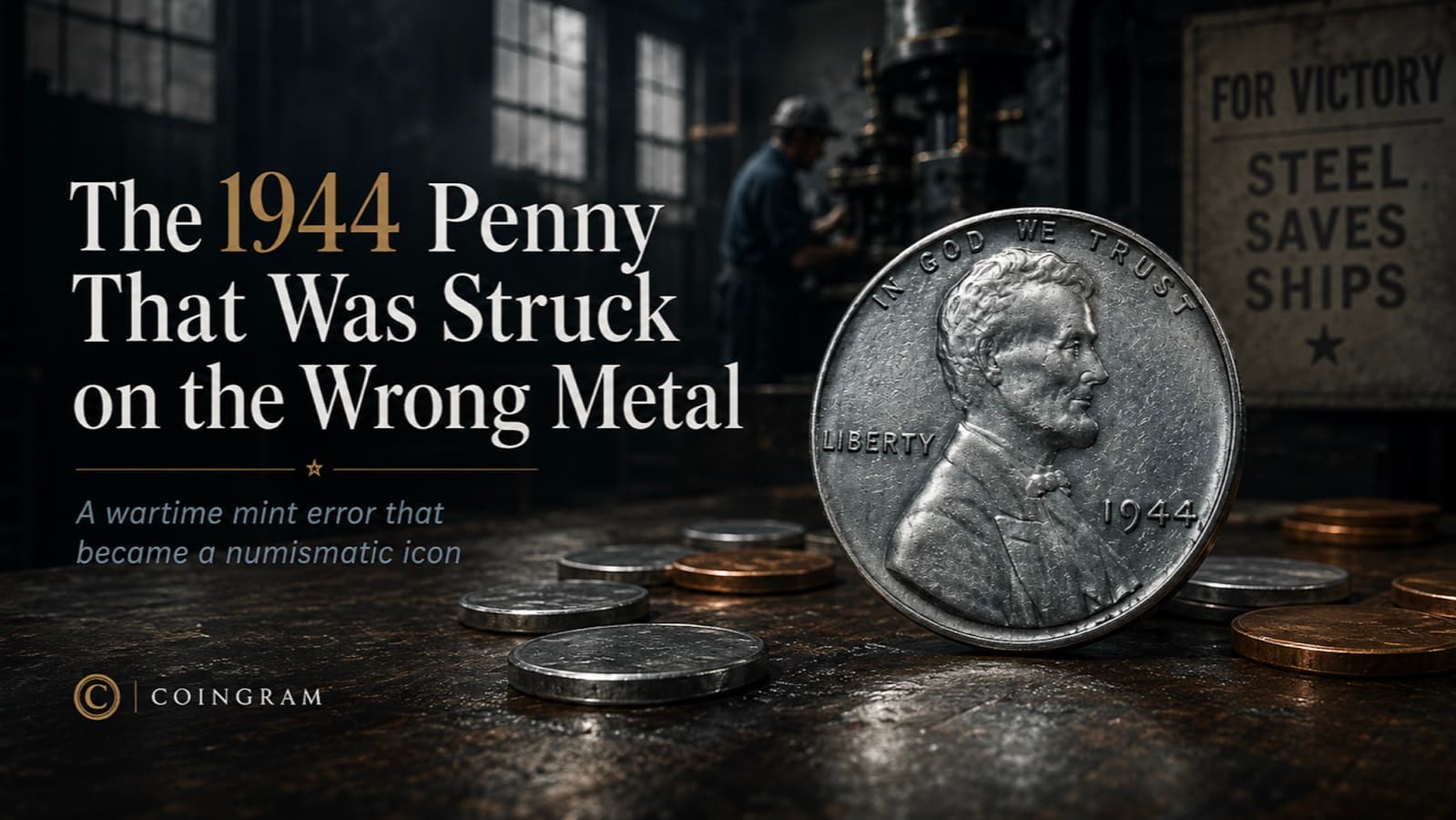
A 1944 Lincoln cent struck on a steel planchet realised $23,790 at Heritage Auctions on 29 June 2026.
At first glance, that may sound surprising. A one-cent coin from 1944 is common. In fact, more than 1.4 billion Philadelphia Mint Lincoln cents were struck that year.
But this was not an ordinary 1944 cent.
It was made from the metal that belonged to the previous year.
That is what turned a coin intended for everyday change into one of the most recognisable wartime errors in American numismatics. Important clarification: Heritage’s entire 29 June 2026 Error Coinage Showcase Auction realised $341,470. The 1944 steel cent itself realised $23,790.
A Coin Created in the Middle of a Wartime Transition
In 1943, the United States Mint replaced the usual bronze cent with a zinc-coated steel version. Copper was strategically important during the Second World War, and the change was meant to reduce the amount of copper used for small-denomination coinage.
The steel cents were intended as a temporary solution.
By 1944, the Mint had returned to bronze cents. A normal 1944 Lincoln cent should therefore be bronze in colour, not steel-grey.
That makes the error instantly understandable:
- 1943 steel cent: normal wartime production
- 1944 bronze cent: normal post-transition production
- 1943 bronze cent: rare wrong-metal error
- 1944 steel cent: rare wrong-metal error
The 1944 steel cent is the reverse side of the famous 1943 bronze-cent story. In both cases, a planchet from the wrong production stream was struck with dies dated for the following or previous year.
The Coin That Sold in June 2026
The Heritage example was described as a 1944 Lincoln cent struck on a 2.9-gram steel planchet and graded PCGS VF35.
It sold for $23,790.
The price was not based on the metal. The coin contains no precious-metal value that could explain the result. Its value came from the fact that it should never have existed in that form.
For collectors, this is the appeal of a true transitional error: the coin captures a production mistake at the exact moment when a national mint was changing metals, changing processes and responding to the pressure of war.
How Could a 1944 Steel Cent Exist?
The most common explanation is simple: a steel blank intended for 1943 production remained in the system and was later struck with 1944-dated dies.
However, the story may not always be that straightforward.
PCGS notes that some 1944 steel-planchet cents may also have been struck on blanks intended for foreign coinage. During 1944, the United States Mint produced 2-franc coins for Belgium, and their planchets could be difficult to distinguish from the steel blanks used for U.S. cents.
That possibility makes the 1944 steel cent more interesting, not less.
It is not merely a coin struck on the “wrong” metal. It may be evidence of the complexity of wartime minting, when several metals, contracts and production streams could exist inside the same facility.
Why Is It So Rare?
A 1944 cent in bronze is extremely common. The Philadelphia Mint alone produced more than 1.4 billion pieces.
A 1944 cent in steel is not.
PCGS estimates that the surviving population of 1944 steel cents is roughly 25 to 30 examples, although the exact number is difficult to establish because some pieces have been damaged, altered or incorrectly identified over the decades.
That rarity alone matters, but rarity is only one part of the equation.
The error is also easy to explain. A collector does not need specialist knowledge of dies, varieties or microscopic markers to understand the central story: in 1944, the coin should have been bronze. This one was steel.
That clarity gives the coin broad appeal far beyond advanced Lincoln-cent specialists.
Why Condition Still Matters
The Heritage coin was graded VF35, which means it was circulated and showed clear wear.
Even so, it realised $23,790.
That demonstrates an important principle in numismatics: when a coin is rare enough, historically meaningful enough and authentically certified, demand can remain strong even outside Mint State condition.
A high-grade example would likely bring much more. But the VF35 coin still possessed the one feature that could not be replaced: it was a genuine 1944 steel cent.
For rare errors, the order of importance is often:
- Authenticity
- Correct attribution
- Rarity
- Historical context
- Condition and eye appeal
All five matter, but without the first three, the rest have little meaning.
A Useful Lesson for Collectors
The story also comes with a warning.
Not every grey-looking 1944 cent is a rare steel error. Many ordinary bronze cents have been plated, altered or damaged. A magnet can be a useful first screening tool because genuine steel cents are magnetic, but magnetism alone does not prove authenticity.
Collectors who believe they have found an unusual 1944 cent should avoid cleaning, polishing or modifying it. The sensible next step is to weigh it accurately, photograph both sides and seek an opinion from a respected dealer or established third-party grading service.
The difference between an altered cent and a genuine wrong-planchet error can be enormous.
More Than a Coin Error
The 1944 steel cent matters because it sits at the intersection of history and accident.
It is connected to wartime metal shortages, emergency coinage, industrial production and the human reality that even a national mint can make mistakes.
A tiny one-cent coin became valuable not because it was designed to be rare, but because it was struck at exactly the wrong moment on exactly the wrong metal.
That is what makes numismatics so compelling.
Sometimes the most valuable stories are not planned by kings, governments or engravers.
Sometimes they happen by accident.